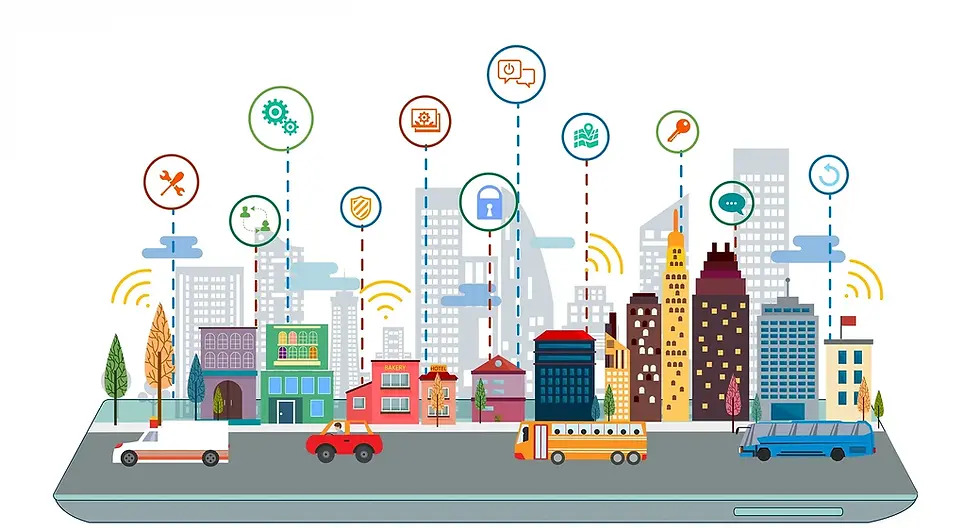
Smart Cities

What is a smart technology? What is a smart city? A smart technology is a system which takes its own decision. A smart city is an integration of the technologies for better urban planning for physical and social infrastructure, transportation and land use development. These technology collects data from from urban area or assimilate data for urban areas. As of today, smart city concept is seen as an part of information technology. However, in future it is evident that smart cities technology will be beyond information technology, but integrated with artificial intelligence, machine learning and block chain system. The basic approach for city planning are two way: a) top to bottom approach, and b) bottom to top approach. Generally, top to bottom approach include master planning for cities where land is controlled though various statutory obligations on the citizens. One of the significant ways to solve the city problems are bottom to up approach. In this approach, the citizens are involved in planning, execution and management of the cities. This process is know as community participation. In global context, particularly in USA and Japan, cities apply bottom to top approach for city planning. In Japan,
Machizukuri is a process in which community participation provides effective solutions for solving problems in old and newly planned cities. Similar, in USA community participation is developed through variety of innovative models to make the cities efficient.

Reading about smart cities instantly reminded me of the weekend I spent in Barcelona last spring, when the city’s public transport was practically a living demo of the concepts you describe. I hopped on a bus that knew exactly how many seats were free and adjusted its route in real time to avoid a sudden surge of tourists heading to the beach. Later, I walked through a neighborhood where streetlights dimmed automatically as I approached, saving energy while still keeping the path well lit https://web.archive.org/web/20120805200217/http://www.justice.gov/usao/nys/pressreleases/july12/pokersettlement.html The seamless integration of sensors and data felt less like futuristic hype and more like everyday convenience. It made me realize how much of that technology could improve smaller towns back home, where traffic jams…
Reading about smart cities sparked a memory of my first week living in a newly renovated district of Portland that was marketed as a “connected neighborhood.” The streetlights dimmed automatically when the sky grew dark, and a sensor in the park turned on the irrigation only when the soil was dry, saving water without anyone having to lift a finger. I remember stepping out of my apartment to find a bike‑share dock just a block away, the app showing real‑time availability, and feeling oddly proud to be part of a system that seemed to anticipate my needs https://en.wikipedia.org/wiki/Game_of_skill It wasn’t flawless—there were occasional glitches with the traffic‑flow sensors, and the Wi‑Fi in the community hub was spotty during rush hour—but…
Reading about smart cities sparked a memory from a week ago when I visited a newly renovated district in my hometown. The streets were lined with sensor‑controlled lighting that dimmed as I walked past, and a digital kiosk offered real‑time bus arrivals in multiple languages. I was especially impressed by the bike‑share stations that automatically adjusted the number of bikes based on demand, something I’d only heard about in tech blogs before https://www.justice.qld.gov.au/about-us/services/liquor-gaming/contact-us/lg-complaints While waiting for a tram, I noticed a small display showing air‑quality data, which made me think about how much more transparent urban living can become. It felt like stepping into a prototype of the future, yet everything was designed for everyday convenience rather than flashy tech.…